Tuesday, March 29, 2011

Farewell, Dear Friends


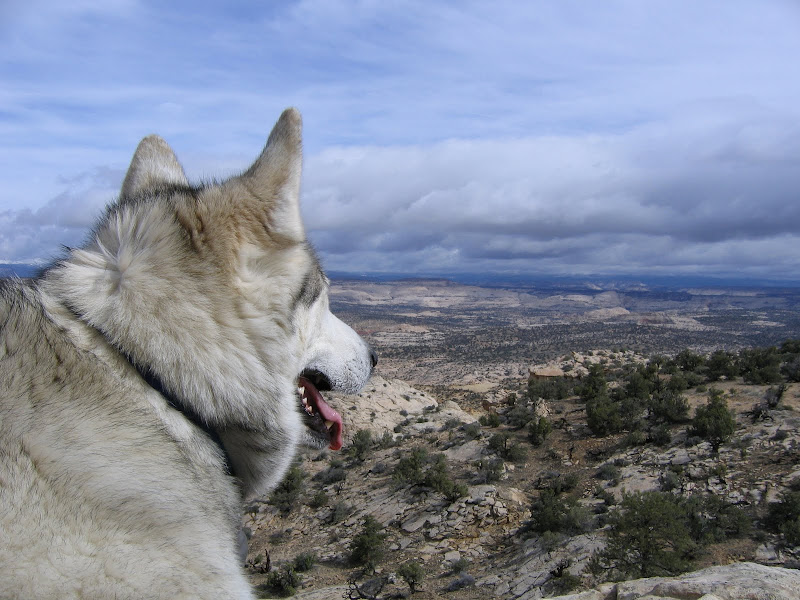
In February of 2000 I was blessed with an incredible gift - the companionship of two beautiful husky/malamute sisters - Tasha and Kia. These large, wonderful creatures became a significant part of my life, sharing adventures and good times that stretched across eleven years and the span of the Four Corners region.

Time passes all too quickly. Hours become days become weeks become months, then years are gone before we realize that what once seemed forever was just an illusion. Even though I knew this day would come, I never thought it would be over so soon.


Two dogs from the same litter could not have been more different. Tasha was independent to the point of aloofness, although that was just a facade. She played the role of Alpha in the relationship and was jokingly called the "fun police" because she could not bear to see her sister having a good time. Despite her overbearing tendencies she was very much a loving dog, albeit on her terms.


Kia was the "love sponge", seemingly incapable of receiving enough affection. Though she played second banana to her dominant sister, she was every bit her equal in size and strength, but her gentle nature was of the live and let live variety.


Together these furry canines traveled with their semi-nomadic master, first from their birthplace in Wyoming to northern Arizona, back to Wyoming several years later, finally landing in Flagstaff for the balance of their years. In between we wandered far and wide through the mountains and canyons of the Colorado Plateau. Though the dogs were built for snow, they gladly adapted to whatever environment they found themselves in. Like me they were just happy to be out and about, enjoying fresh air, freedom, and the endless diversion of chasing rodents and lizards.

The years raced by, and like many older, large breed dogs "the girls" slowed down noticeably over time. Hours long walks in the woods became 15 minute strolls around the immediate neighborhood. Even so the quality of their life was good, and as spoiled pets they spent much of the day sleeping in the yard or on one of several beds in the house. Though their energy levels had diminished, just knowing they were around and happy was enough, and they seemed content to age gracefully.

Towards the end both dogs began to exhibit troubling signs. In Tasha's case there was a gradual loss of appetite, and she started vomiting after activity. Kia began to display symptoms consistent with tumors in her abdominal cavity, a development I had been warned about and dreading since the removal of a similar growth two years before.


Tasha was the first to go, in late March. The veterinarian concluded she likely had some form of intestinal cancer, and the prognosis was unfavorable for treatment. With a heavy heart I decided to euthanize her, and was there with her when the end came. My sadness at her passing was absolute, and her absence from my life left me feeling desolate.

Despite the burden of grief I turned my attention to my remaining dog, Kia. Although her condition was also worrisome to me, outwardly she was very much herself, going for short walks and soaking up as much attention as she could get. I knew that eventually the tumors would kill her as they continued to grow, but my hope was that she would go peacefully in her sleep, sparing me another agonizing decision on whether to end her life.


As the weeks passed, Kia also began to refuse food. Initially there was some success in getting her to eat chicken and beef, but soon even those lost their appeal. Despite appearing reasonably normal in her personality, once she stopped eating I knew it was simply a waiting game. I could not bear to watch her starve to death.

For the second time in just over two months I made the only decision a caring pet owner can make – to spare my dog additional suffering. I waited with her while the vet administered the lethal drug, whispering assurances of love and appreciation for her companionship while stroking her head and neck. She went as peacefully and quickly as I could hope for, and in seconds it was over.

My dogs are gone. I know I made the right choice in letting them go. I take comfort in knowing they had good lives, and at the end their suffering was as little as I could make it. The short lifespan of a dog makes it inevitable that as caretakers we must watch our once healthy, thriving companions lose their vitality and eventually their life. All we can do as humans is to ensure that life is meaningful and full of as much love as we can offer.

Time will eventually blunt the sharp knife of grief, and someday I will once again be able to walk through my life without constantly thinking about the hole their absence has left. For now, I miss them terribly.

Kia and Tasha - I don't know what happens when we leave this life, but I hope there's a way for you to know you'll be in my thoughts and heart for a long time to come. Thank you for eleven amazing, wonderful years of love, devotion, and companionship. I will treasure your memory always. Be at peace, and may we meet again.




Sunday, January 30, 2011

Grand Falls - Ephemeral Grandeur


What makes the western landscape so visually appealing are geological marvels shaped from the very bones of the Earth, apparently timeless monuments that appear unchanged over the lifespan of humans. It is rare that processes creating such splendor become the attraction, however Grand Falls is one such exception.

When people think of mighty torrents plunging into the depths, places like Niagra, Victoria Falls in Africa, or maybe Venezuela's Angel Falls come to mind. But longtime northern Arizona residents know another name - the Grand Falls of the Little Colorado River. This amazing natural wonder is not familiar outside the region primarily because it only occurs for a short while, and only after an especially snowy winter.

The Little Colorado is a tributary of the West's most famous waterway, the Colorado River. With headwaters forming in the higher elevations of the White Mountains of Arizona, the Little Colorado gathers snow melt in the spring, and transports it from east to west across the relatively flat Painted Desert. Where the river approaches the San Francisco volcanic field near Flagstaff, an ancient lava flow from Merriam Crater filled the river channel, forcing the water from the original bed.


After the diversion the river eventually reentered the natural drainage, resulting in the falls. Over the last several thousand years water has continued to erode the underlying Kaibab limestone resulting in a stairstep cascade. Overall there is a drop of more than 185 feet to the base of the falls, making Grand Falls taller than Niagra.


When the flows are near or at their peak, the spectacle is truly amazing. The river picks up enormous amounts of clay and silt from easily eroded badlands upstream, and this results in a muddy brown torrent. As sediment laden water plunges into the cataract, it is easy to see why earlier visitors dubbed the feature Chocolate Falls.


Finding the falls can be somewhat of an adventure, especially for the directionally challenged. The remote area is located on the Navajo Indian Reservation northeast of Flagstaff. While the initial approach uses paved roads, a significant portion occurs on primitive and poorly marked dirt "highways". I think the directions found on the Navajo Nation Parks site are the most accurate, although it suggests using four wheel drive. I have found a high clearance vehicle to be adequate, but the road is frequently very rough and washboarded.


The spectacle only lasts as long as the snow, and dry years often mean little or no water in the river. It is possible a heavy summer rain will generate enough flow for a decent display, but this lasts an even shorter period of time and it can be difficult or impossible to reach the site if roads are washed out or muddy.

If you find yourself visiting northern Arizona in the spring after a heavy winter, the falls are definitely worth checking out. To find out if there is enough water to make the journey worthwhile, check the stream flow data from the U.S. Geological Survey website here. In general flows above 1000 cfs mean the river is running high enough to justify a visit. If your timing is right you will witness a sight that is both awe inspiring and unexpected in the high desert.

Friday, January 28, 2011

Sinks Canyon - Wyoming!


My blog is devoted almost entirely to landscapes of the Colorado Plateau, as it is my favorite place which coincidentally happens to be located in my backyard. Occasionally I venture further afield than northern Arizona and Utah, and last summer I took advantage of extra free time and pushed farther north into Wyoming.

It was a trip into the past, as I once lived and worked in the Cowboy State. I came here first in the mid-1980's, drawn by vast open spaces and the fascinating frontier history of the area. I was fortunate enough to find a job in Cody for the summer, which was an amazing experience. That introduction led me to explore the entire state, and on that first journey I stumbled upon what I consider one of the most interesting and beautiful State Parks found anywhere in the west - Sinks Canyon


Over the years I returned to Wyoming several times to work and play, and Sinks Canyon became a favorite destination. It has changed very little in the last two decades, and I was happy to spend a few days reacquainting myself with the sights and sounds of this fascinating area. Located at the southern end of the rugged Wind River Mountains just north of Lander, Sinks Canyon was carved by the tumbling Popo Agie River. Popo Agie is pronounced “poe-poe-zhuh” with the “zhuh” sounding like the “sia” on the end of amnesia. The meaning translates as something like "gurgling river" and is from the Crow Indian language.


The forested canyon and boulder strewn torrent of the river are beautiful in their own right, however what makes the area even more interesting is the "mystery" of the river, specifically a phenomena called the Sinks, which gives the canyon its name.


The river, which boils and seethes in the channel upstream, disappears from the surface at the Sinks, going underground for nearly half a mile. It emerges in a much more subdued manner at the "Rise", a long pool filled with very fat and happy fish.


I say fat and happy because the fish are protected - no fishing is allowed at the Rise. In addition, State Park staff have provided a coin operated vending machine dispensing fish food, which visitors are all too happy to plug money into. The fish spend their day hovering beneath the viewing platform, waiting for the rain of nuggets from above. Fighting over food seems to be the extent of activity they get, but I'm sure they don't mind.

For those seeking an educational experience about the geology of the region including the Sinks, the Park has a small but excellent Visitor Center with exhibits and information regarding different facets of the canyon, including wildlife displays and historical artifacts from the earliest inhabitants.

One of my favorite aspects of the Park is a campground located on the banks of the river. Those who need all the bells and whistles for their RVs take note - there are no hookups, the sites are small, and only pit toilets exist for sanitation. Even so, there are more positives than negatives here. Most sites are within 25 feet of the water, and the white noise of the river provides a soothing backdrop for relaxing and sleeping.


Another great feature here is the Volksmarch Trail - volksmarch is a german word meaning "people walk". This nearly 10 mile long hike leads upstream to Popo Agie Falls, following the river high on the east bank through meadows and forest. Those who want a less strenuous outing can walk the much shorter Nature Trail, a one mile loop just across the river from the campground. Beautiful summer flowers abound along the way, inviting visitors to stop and admire the display.


In my book, Sinks Canyon is about as good as it gets, especially for a State Park right off the highway. The spectacular canyon setting includes interesting geology and a raging river at the doorstep of my camper, as well as great hiking and wildlife watching. It's a worthwhile destination, and I'm looking forward to another visit in the near future.